6 October 2026 · 11 min read
Community Pizza Fire: Wood-Fired Ovens and Venues
Searching for community pizza fire? Discover the truth about wood-fired community ovens, safety rules, and the popular Community Pizza & Beer Garden.
What does “community pizza fire” refer to: a restaurant in Texas, a shared oven in a public park, or a fire-related news story involving a pizzeria? The phrase sounds specific, but search results connect several unrelated ideas, making it easy to plan the wrong trip, copy unsafe oven advice, or confuse one business with another.
The useful distinction is between community as a dining brand and community as a shared cooking project. One points to a wood-fired restaurant and beer garden in Wimberley, Texas. The other concerns the operation, maintenance, and regulation of an open-fire oven used by neighbors, civic groups, or homeowners. A third group of results involves similarly named pizza businesses and unrelated restaurant fires.
Table of Contents
- Untangling the Community Pizza Fire Search Confusion
- Mastering Thermal Management in Community Wood-Fired Ovens
- Critical Safety and Compliance Rules for Open-Fire Pizza
- Inside the Community Pizza and Beer Garden Experience
- The Evolution of Fast-Casual Pizza Expansion Models
- How to Choose the Right Community Pizza Destination
Untangling the Community Pizza Fire Search Confusion
Searchers encounter this confusion because “community pizza” works as both a commercial identity and a description of a civic activity. A restaurant can use the word to suggest neighborhood atmosphere, shared tables, and informal hospitality. A public oven project uses it more directly, describing a facility where people gather to cook together.
The best-known venue connected to the phrase is Community Pizza & Beer Garden in Wimberley, Texas, listed at 111 Old Kyle Road. Available listings describe wood-fired pizza, beer, appetizers, and brunch, with a setting intended to welcome families and groups. That information identifies a dining destination, not a public oven project.
Other searches take users toward backyard construction guides, open-fire operating advice, or news about restaurant fires. Those results may contain useful safety information, but they don't establish a connection to the Wimberley business. A story about a pizza restaurant damaged by fire, for example, shouldn't be treated as evidence that the venue itself operates a community oven or that its fire practices caused an incident.
Three different meanings behind one phrase
- A Texas restaurant search: Look for the Wimberley address, menu details, opening information, and current customer experience.
- A shared oven search: Focus on thermal management, fuel, operating procedures, public liability, and local permissions.
- A fire-news search: Verify the restaurant name, city, and incident before drawing any connection to “Community Pizza.”
The gap is practical. Existing listings offer scattered menus and reviews, but they don't clearly answer whether similarly named businesses are connected, whether the beer garden suits children or dogs, or how dietary requests are handled. Readers need location verification before they need a list of “best dishes.”
Mastering Thermal Management in Community Wood-Fired Ovens
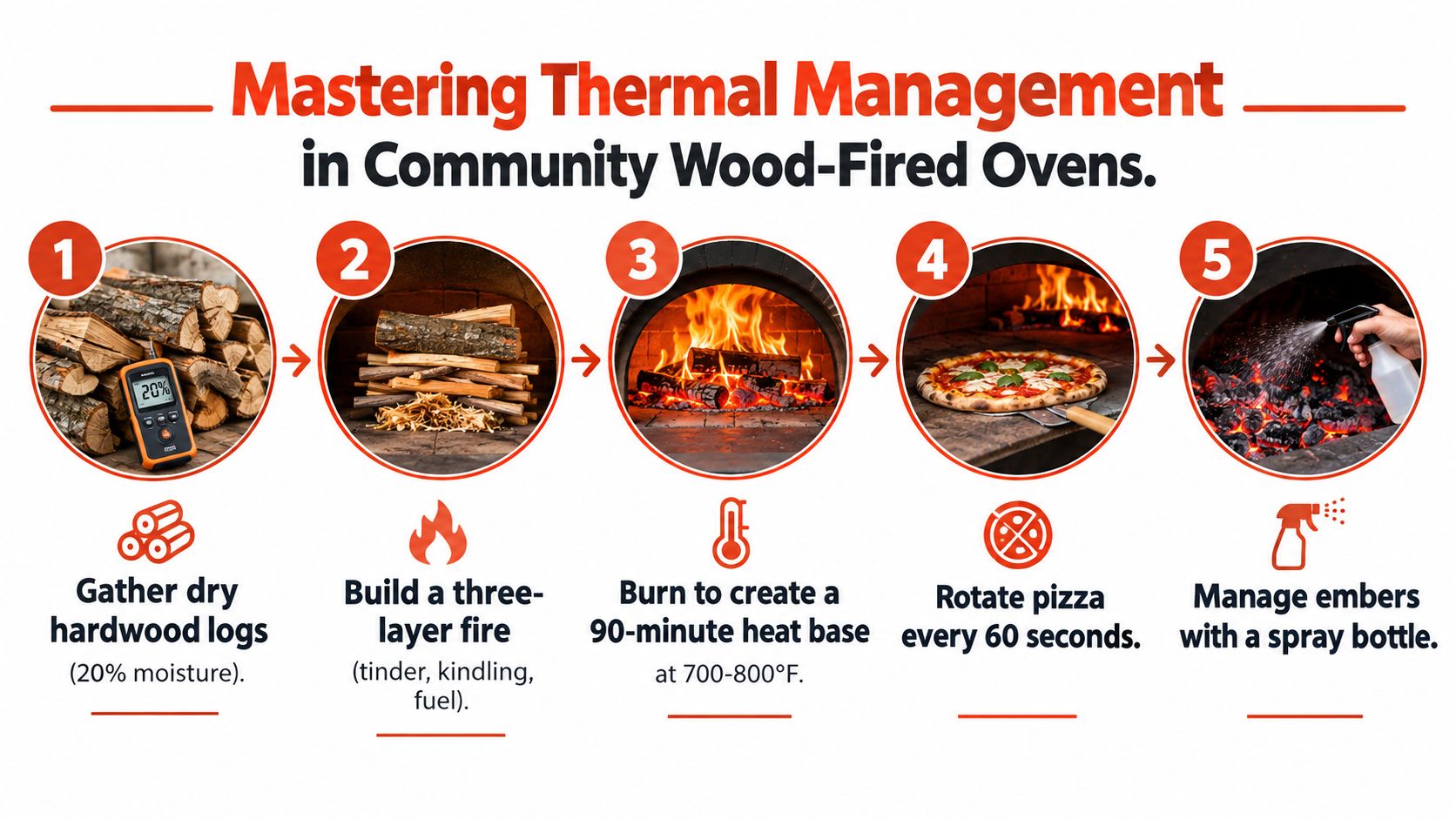
A community wood-fired oven isn't managed by flame alone. The refractory dome and cooking floor store heat, so the operator must plan a temperature descent that matches each food to the oven's changing condition.
For pizza, the initial operating phase should be approximately 300 to 400°C, according to Albury City's guidance for wood-fired ovens. That peak period is the logical time for pizza because the floor and dome are hottest. Once the pizza session ends, the oven can transition to roughly 250 to 300°C for bread, then approximately 180 to 250°C for roasting and baking.
Why the order matters
Starting with bread or roasting would waste the oven's hottest phase for food that doesn't require it. Reheating between dishes also consumes fuel and interrupts the rhythm of a shared bake day. A better sequence uses the oven's stored heat progressively, moving from pizza to bread and then to lower-temperature cooking.
That sequence also gives organizers a workable schedule. Pizza makers go first, bakers follow, and people preparing roasts or baked dishes use the residual heat later. The approach reduces unnecessary reheating and makes a single firing useful for several types of food.
Practical rule: Treat the oven as a heat bank with a planned decline, not as a grill that stays at one temperature.
The following video can help participants visualize the relationship between fire position, hot surfaces, and cooking space before they work in a shared oven.
Temperature readings still need careful interpretation. Different ovens, fuel loads, weather conditions, and cooking surfaces behave differently, so a community group should establish its own operating routine while keeping the broad sequence intact.
Critical Safety and Compliance Rules for Open-Fire Pizza
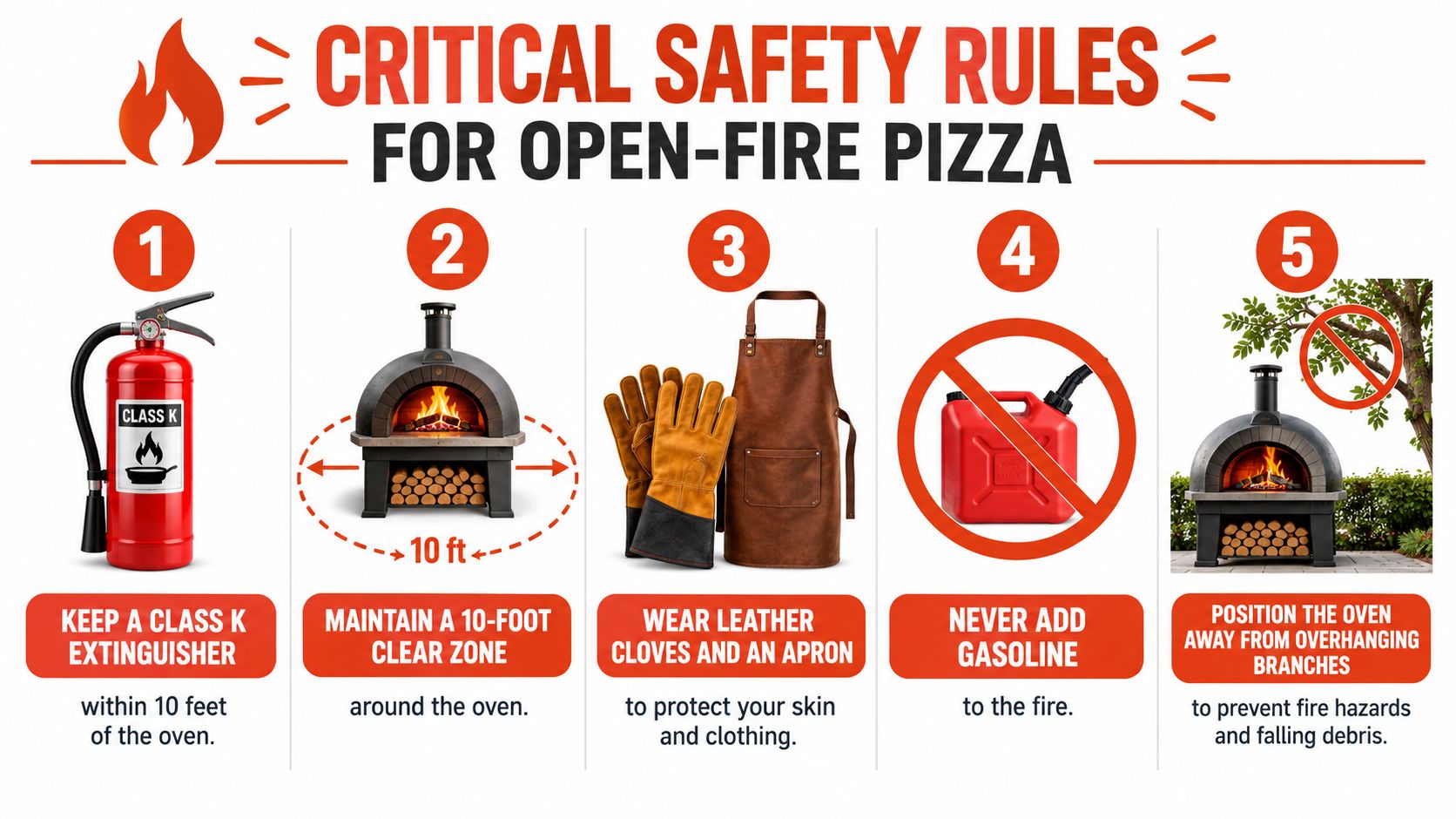
An open-fire pizza oven creates two separate hazards: radiant heat from the oven and airborne embers from the fuel. A safe setup controls both rather than treating a thick oven shell as sufficient protection.
The oven should operate outdoors on a stable, heat-tolerant, noncombustible surface. It must be positioned away from combustible buildings, materials, and vegetation. Wind deserves special attention because it can carry sparks and embers beyond the immediate cooking area.
Controls that should be in place
- Fire response: Keep appropriate firefighting equipment immediately accessible, not stored inside a distant building.
- Protective tools: Use long-handled implements and heat-resistant gloves when moving fuel, pans, or embers.
- Ash disposal: Put cooled ash in a metal container rather than a plastic bin or a combustible waste container.
- Weather judgment: Postpone or modify an outdoor firing when wind could transport embers toward structures or dry vegetation.
- Indoor exclusion: Don't operate a fuel-burning oven indoors unless the design, ventilation, and local rules specifically permit it.
Indoor use introduces carbon-monoxide and structural-fire hazards. Outdoor placement reduces some risks, but it doesn't remove the need for clearance, chimney, and spark-control decisions.
Verify the rules before construction
Local requirements vary. Setbacks, chimney specifications, spark-arrestor rules, and burn-ban restrictions depend on the jurisdiction and the type of installation. The open-fire pizza oven compliance guidance recommends checking those requirements before installation rather than after the oven is built.
A community project should assign responsibility for setup, firing, supervision, and shutdown. That division matters because a public oven has more users and more opportunities for unsafe handling than a private appliance.
Inside the Community Pizza and Beer Garden Experience
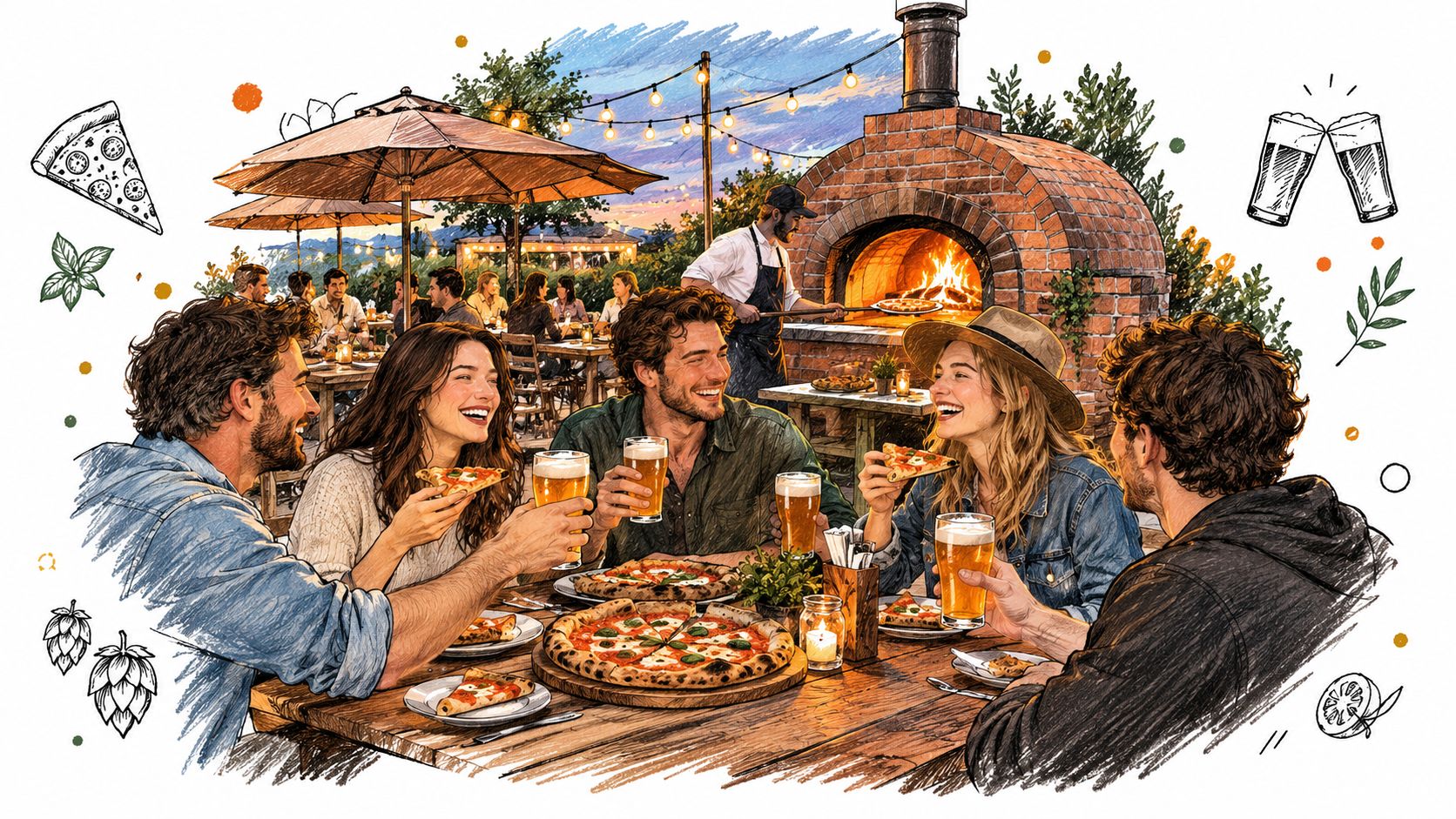
The commercial venue behind much of the search confusion is Community Pizza & Beer Garden in Wimberley, Texas, at 111 Old Kyle Road. Listings describe wood-fired pizza, beer, appetizers, and brunch, with a family- and group-friendly setting. Those details make it a plausible destination for travelers seeking casual outdoor dining, but they don't answer every practical question a visitor may have.
Customer commentary is mixed on value. Some reviews praise the food and service, while another describes the restaurant as “horribly expensive,” a criticism recorded in the Community Pizza & Beer Garden listing on Trip.com. That disagreement doesn't prove that one side is right for every diner. It suggests that expectations, order size, group composition, and spending tolerance shape the experience.
Who may find it a good fit
Families may value the informal beer-garden setting and menu breadth, but parents should confirm current policies on children, dogs, seating, and noise before visiting. Couples may prefer the wood-fired atmosphere and drinks, while large groups should ask about table arrangements, wait times, and whether separate checks are available.
Dietary planning requires more care than a menu label alone. A pizza may be customizable without being suitable for someone who needs strict gluten-free or vegan preparation. Visitors should ask which items are vegetarian, vegan, or gluten-free and whether the kitchen can control cross-contact.
A short video can also help a restaurant show its atmosphere, service flow, or wood-fired preparation more clearly than a static menu. Teams exploring that format can review video editing for social media as a separate content workflow, but visitors should still rely on current venue information for practical decisions.
The central limitation is identity. A listing for Community Pizza & Beer Garden doesn't establish that it is connected to every business using the words “Community Pizza,” and it isn't evidence about public oven projects elsewhere.
The Evolution of Fast-Casual Pizza Expansion Models
The word “community” can also describe a fast-casual brand strategy rather than a shared civic facility. PizzaFire, founded in Ohio by Sean Brauser and Bruno DiFabio, opened its first reported location in Akron in October 2014 and publicly targeted 100 units across the Midwest within six years, as documented by Fresh Water Cleveland's report on PizzaFire's expansion.
That model differs sharply from a neighborhood oven. A fast-casual operator chooses compact sites, designs a repeatable service format, and uses restaurant infrastructure to support expansion. A shared oven project usually grows through local organization, fundraising, volunteer labor, permissions, and long-term maintenance. Both may use community language, but they measure success differently.
Two meanings of scale
PizzaFire's early expansion period included a Cleveland location at 236 Euclid Avenue, a 2,500-square-foot downtown site with seating for approximately 70 customers, according to the same report. Those details show how a restaurant can use a relatively compact urban footprint to support customer turnover and brand visibility.
The company also benefited from the founders' existing Romeo's Pizza operation. That business had begun in Medina in 2001 and was reported in 2015 to have 34 Ohio locations, approximately 700 employees, and $22 million in annual sales, placing PizzaFire within a broader pizza-enterprise network rather than an isolated startup. These figures describe the surrounding business context, not a public community oven.
A shared oven pursues a different kind of reach. Its value may come from teaching, gathering, and shared access rather than unit count. That doesn't make one model more authentic than the other. It means readers should stop treating franchise expansion, neighborhood dining, and civic cooking as interchangeable forms of “community.”
For marketers and restaurant owners, even seemingly small decisions about format and space can shape the customer journey. A separate discussion of 4:5 size may be useful when adapting visual content for social platforms, but it says nothing about whether a pizza brand operates a communal oven.
How to Choose the Right Community Pizza Destination
The common assumption is that a search result with “community,” “pizza,” and “fire” must identify one recognizable place. It doesn't. The better approach is to decide what outcome you want before judging a venue, project, or article.
If you're planning a meal
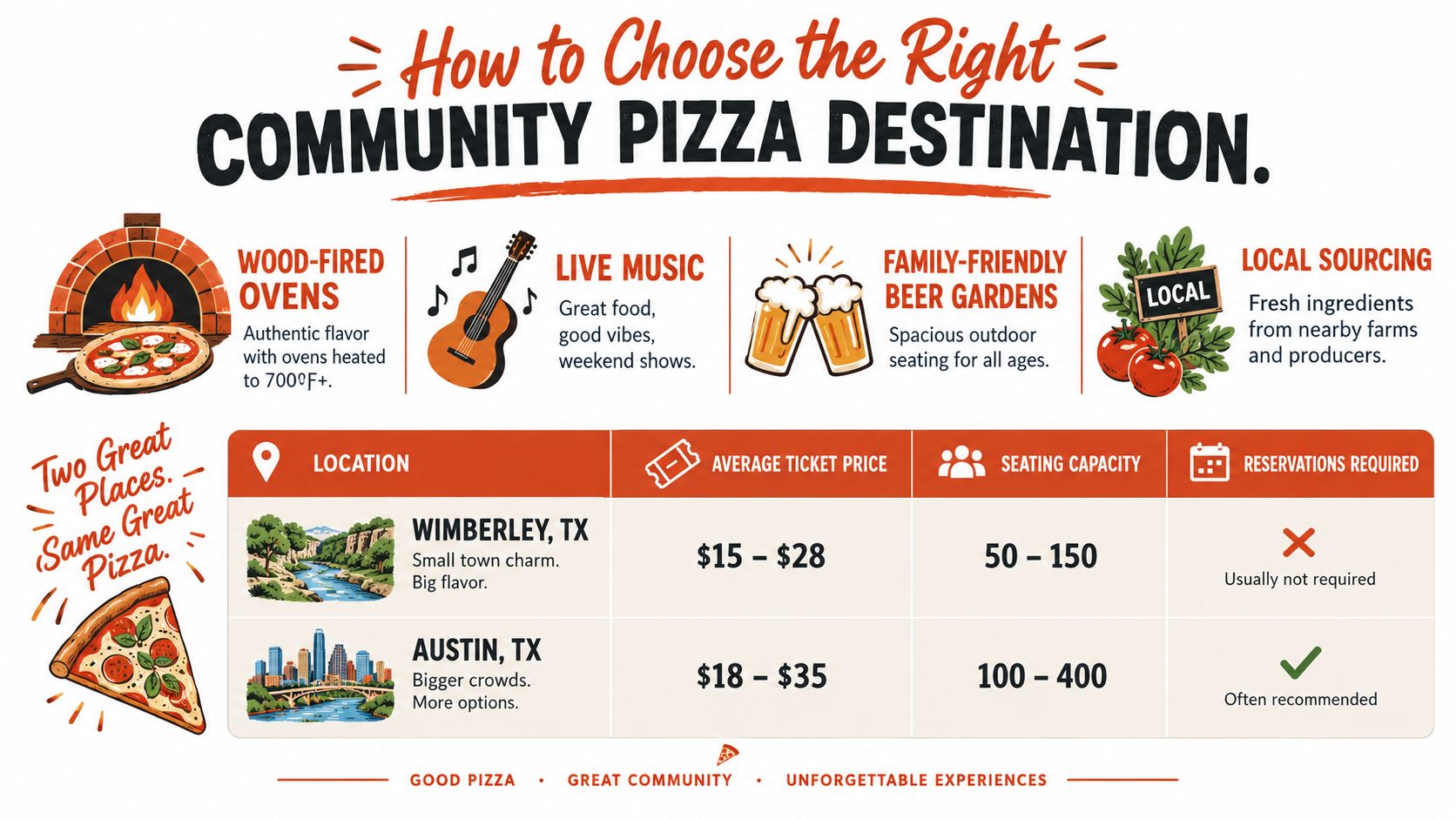
Start with the address. For the Wimberley venue, verify 111 Old Kyle Road, then check the current menu, opening information, seating arrangements, and group policies. Ask direct questions about children, dogs, noise, reservations, and dietary preparation instead of inferring the answers from the phrase “beer garden.”
Reviews can help reveal differences in service and perceived value, but they shouldn't replace current first-party information. The conflicting feedback about price makes it especially important to establish what your party plans to order and whether the venue's atmosphere matches the occasion.
If you're planning an oven
Your checklist is different:
- Define the users: Decide who can fire, cook, supervise, and close the oven.
- Plan the heat cycle: Use the hottest phase for pizza, then move to bread and lower-temperature baking.
- Choose the site: Use a stable, noncombustible outdoor surface away from structures and vegetation.
- Confirm compliance: Check local clearance, chimney, spark-control, and burn-ban rules before construction.
- Prepare shutdown procedures: Control tools, protective equipment, ash storage, and post-fire inspection.
A homeowner may need a private installation review. A civic group may also need rules for access, training, insurance, and event supervision. Those questions matter more than whether the oven looks like one seen in a restaurant video.
Decision point: Choose the destination that matches your intent, not the one that merely matches your search phrase.
Whether you're comparing restaurant experiences, organizing a neighborhood bake, or deciding if a content idea is worth developing, a clear value test helps. The practical question is whether the result gives your audience enough context to act, much like the principle behind that's a good deal.
If you're turning restaurant visits, oven demonstrations, or local food interviews into social content, Keptbits can identify self-contained moments from long recordings, cut them at natural word boundaries, and add speaker-aware framing and captions. Upload a full conversation or event video, then create vertical, square, or widescreen clips ready for publication.
Keptbits cuts on sentence boundaries.
Paste a link or upload an episode, say how many clips you want, and get them back captioned and vertical. The free plan needs no card.
Start freeRead next
7 Online Video Editor Free Picks That Deliver in 2026
Compare 7 online video editor free options for 2026, including watermark limits, export quality, key features, and the best use for each tool.
How to Make Viral Video on YouTube in 2026
Learn how to make viral video on YouTube with proven hooks, thumbnail tests, retention fixes, and Shorts workflows that actually convert viewers into
How to Make YouTube Channel Setup That Actually Grows
Learn how to make YouTube channel setup that grows: account, branding, first videos, optimization, and monetization milestones explained step by step.